

Because the Great Migration is a continuous, year-round cycle from place to place, there is no one time of year that is ideal for seeing it. Nonetheless, your safari can be customized to give you the best chance of seeing what you want, based on the time of year you choose to travel or the part of the Great Migration you want to see (such as river crossings).
More than 6,000 wildebeest calves are born every day in the Ndutu Conservation Area and Serengeti South, which is said to be the birthplace of wildebeest life. These calves then migrate north to the Serengeti North and, eventually, the Masai Mara in Kenya. These four seasons might be used to summarize the Great Migration.
Alternatively, this month-by-month description of the Great Migration will help you figure out when to travel. You can witness a wide range of breathtaking scenes, whether the big herds are calving in the south or moving north in pursuit of better pastures and then returning.
The Wildebeest Migration is a year-round, cyclical migration with a variety of equally spectacular activities, despite the common misconception that it only happens from July to October. The belief that the wildebeest are only active or visible during this time of year stems from the fact that the popular river crossings typically take place during the peak safari season, which runs from June to. October
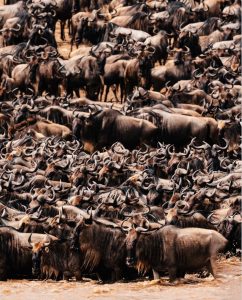
Is it possible to forecast or know when the major river crossings for wildebeest migration would take place?
> Simply, is they migrating in order to graze and breed,
By calling and luring the wildebeest cows, the bulls start the mating ritual. This is where an estimated 600,000 wildebeest cows and 200,000 wildebeest bulls meet. Through their noses, the dominant bulls emit a very clear calling sound. A reverberation that was almost frog-like.
The plains are crowded with them. both in terms of quantity and sound. It is thought that for further protection, make sure all calves are born at the same, then, the wildebeest get ready to head south in search of the Serengeti’s bountiful grasslands regions in mid-October, after the majority of the grasses on the Mara savannah have been consumed. to give birth to their young on Tanzania’s Ngorongoro Crater plains. The wildebeest will start to move once more when the region starts to dry out and the grasses and water become scarce. According to scientists, the ancient wildebeest can use lightning and thunder as a guiding light to detect water up to 50 kilometers away. The herds will be prodded forward by these patriarchs. seeking greener pastures and water. going back to the Masai Mara and starting the life cycle anew.
The Masai Mara Ecosystem benefits from the presence of wildebeests. The Mara grassland is thought to be fertilized by the 60,000 tons of excrement they leave behind.